Mindful Eating: Transform Your Relationship with Food

In today’s fast-paced world, it’s easy to rush through meals without fully enjoying or noticing what you eat. Mindful eating offers a powerful way to reconnect with your food and your body’s natural signals. By slowing down and paying attention, you can cultivate a healthier and more enjoyable relationship with eating.

What Is Mindful Eating?

Mindful eating is about being present and fully aware during meals. It involves tuning into the flavors, textures and smells of your food while also paying attention to hunger cues and emotions. Unlike traditional dieting, mindful eating isn’t focused on restrictions, but instead on listening to your body’s needs and enjoying food without guilt.

Benefits of Mindful Eating

Practicing mindful eating offers several benefits:

  • Better digestion: Eating slowly and chewing thoroughly can improve digestion and nutrient absorption.
  • Weight management: Being mindful helps prevent overeating, making it easier to recognize when you’re full.
  • Enhanced enjoyment: Savoring each bite can make meals more pleasurable and satisfying.
  • Reduced emotional eating: Mindfulness can help you identify triggers for stress eating and make healthier choices.
  • Improved relationship with food: By removing guilt and judgment, mindful eating fosters a more positive outlook on eating.

How to Practice Mindful Eating

Here are simple steps to incorporate mindful eating into your daily routine:

  1. Eliminate distractions: Turn off the TV, put your phone away, and sit at a designated eating spot.
  2. Take a moment of gratitude: Before eating, pause to appreciate your food—where it came from, who prepared it, and its nourishment.
  3. Engage your senses: Notice the colors, textures, and aromas while you’re eating your meal. Take your first bite slowly and savor the flavors.
  4. Chew thoroughly: Aim to chew each bite around 20-30 times, which aids digestion and allows you to enjoy the full taste of your food.
  5. Eat slowly: Put your utensils on the table or on your plate in between bites and take breaks during your meal.
  6. Tune into hunger and fullness: Check in with yourself throughout the meal to gauge your hunger level. Stop eating when you feel satisfied, not stuffed.
  7. Acknowledge your emotions: Notice if you’re eating due to stress, boredom, or sadness. If so, consider non-food ways to cope, like deep breathing or a short walk.

Mindful Eating Exercise

Try this exercise with a small piece of fruit, like a raisin or a slice of orange:

  • Hold the fruit and observe its shape, color, and texture.
  • Bring it to your nose and smell it.
  • Place it in your mouth without chewing and notice how it feels.
  • Slowly chew and pay attention to the sensations and flavors.

Mindful eating is a simple but impactful practice that encourages a balanced and joyful approach to food. It may take time to break old habits, but each mindful bite brings you closer to a healthier and more harmonious relationship with eating.

Start small and be patient with yourself. Over time, mindful eating can become a natural and rewarding part of your life.

Here’s to savoring every bite and living well!

Embracing Walking Meditation

In our fast-paced world, mindful living offers a path to greater presence and peace. One powerful way to cultivate mindfulness daily is through mindful walking meditation. Unlike traditional seated meditation, walking meditation invites movement, nature, and awareness into each step. This practice can be done anywhere—on a walk through the park, a stroll down your street, or even pacing around a small room. Whether you’re new to mindfulness or looking for fresh ways to deepen your practice, mindful walking offers a beautiful way to connect with the present moment.

What is Walking Meditation?

Walking meditation is a form of meditation that combines movement with awareness. Rather than rushing from one place to another, you slow down, walking in a way that allows you to notice the sensations of your body and the world around you. It’s less about reaching a destination and more about being fully present in the journey, using each step as an opportunity to embrace and practice mindfulness.

This practice can be tailored to fit your day, whether you have just a few minutes or want to spend more extended time in nature. As you walk, you can focus on the feeling of your feet touching the ground, the movement of your muscles, the sounds around you, and even the rhythm of your breath. Walking meditation bridges the gap between traditional seated meditation and the active world, making it a versatile and accessible practice for all.

How to Practice Walking Meditation

If you’re new to mindful walking, here’s a simple guide. Aim to walk somewhere quiet if possible, but know that you can practice anywhere—even a bustling city street!

1. Set Your Intention

Begin by setting a clear intention to walk mindfully. Remind yourself that this isn’t about exercise or reaching a destination; it’s about being fully present. You might say to yourself, “I am here to connect with each step.”

2. Start by Focusing on Your Posture

Stand tall, yet relaxed. Feel the soles of your feet connecting with the ground. Bring your attention to the present moment by taking a few deep breaths. Notice how your body feels and allow yourself to arrive fully in this moment.

3. Take Slow, Deliberate Steps

Begin to walk slowly, lifting one foot, moving it forward, and placing it down with awareness. Pay attention to the sensations in your legs and feet—the pressure, the texture of the ground, and the movement of each muscle.

4. Coordinate Breath and Steps

Notice your breathing as you walk. Some people find it helpful to synchronize their breath with their steps—for example, taking two steps as you breathe in and two as you breathe out. You might choose a pattern that feels natural to you, or simply allow your breath to flow freely.

5. Engage All Your Senses

Mindful walking is not just about your body; it’s about experiencing the world around you. Notice the sounds, smells, and sights as you walk. Feel the air against your skin, listen to the rustling of leaves, or observe the light. If your mind starts to wander, gently bring it back to the sensations of walking.

6. Return to the Present When You Drift

It’s natural for thoughts to arise as you walk. When you notice your mind wandering, simply acknowledge it without judgment and bring your attention back to the sensations of walking. The act of returning to the present is an essential part of mindfulness practice.

7. End with Gratitude

When you’re ready to finish, pause for a moment and take a deep breath. Reflect on the experience with gratitude for the time you spent connecting with yourself and the world. You might place your hands on your heart and take a few moments of silence to close the practice.

The Benefits of Walking Meditation

Walking meditation has a range of mental, emotional, and physical benefits. Here are a few ways it can enhance your mindful living journey:

Reduces Stress and Anxiety: Focusing on the present moment helps to quiet the mind, reducing stress and anxiety as you step away from worries and into awareness.

Enhances Focus and Concentration: Walking meditation trains the mind to stay with one task at a time, which can improve focus in other areas of your life.

Increases Body Awareness: By tuning into each movement, you become more connected to your body, helping you notice tension, stiffness, or areas where you can bring more ease.

Connects You with Nature: Walking meditation offers a unique opportunity to experience the natural world with mindfulness, which can foster a sense of connection and gratitude.

Boosts Emotional Resilience: Regular practice can help you build a habit of returning to the present, which can support emotional balance and resilience over time.

Tips for Integrating Walking Meditation into Daily Life

Start Small: Begin with just a few minutes each day. As you become more comfortable, you can extend your sessions.

Practice Anywhere: Mindful walking doesn’t have to be a big event. Try it while walking to your car, in the grocery store, or as you go about your daily routines.

Combine with Traditional Meditation: Walking meditation is a great complement to seated meditation. If you find seated meditation challenging, walking meditation might be a refreshing alternative.

Use Visual Reminders: Place reminders around your home or on your phone to take a few mindful steps throughout your day.

Value Yourself & Others

Sometimes we are faced with the hard choice of how exactly we should measure our value. It can be hard because most people will immediately think of their status in life (career, family, etc.) instead of their self-worth (what is inside of them). We think of all the external aspects and not the internal.

Your attitude towards yourself is EVERYTHING!

With that being said, what is the first thing that comes to your mind when you think of self-worth or value? For me, it is self-esteem. In sociology and psychology, self-esteem reflects a person’s overall subjective emotional evaluation of his/her own worth. It is a judgment of oneself as well as an attitude toward the self. If you are struggling with believing you are a valued individual, it will be hard for you to open yourself up to love.

Though you might find it strange, take a hard look at yourself in the mirror and say “You are AMAZING!” Say it with conviction, knowing that it is true. Each and every one of us is made differently but made amazingly. It is important that we recognize the good traits we have that help increase our self-esteem and value. Some of those traits can be: Kind, Intelligent, Humble, Generous, Nurturing, Patient, Brave, Listener. That is just to name a few. I bet if you look inside yourself, you can think of more traits than that.

Sometimes it can be hard to see the value inside when the outside world is telling you to feel insecure about yourself. I have found that there a few exercises out there that will help you to block out the outside noise and listen to the positive voice within. One way to that is to keep a gratitude journal and in it each day write five good things about that day. Expressing gratitude for even the smallest things helps open you up to not only appreciating the day but in time appreciating yourself.

You can also start a self-esteem journal. I actually found a really good worksheet on a website that has helped me start my own self-esteem journal. The website I found it on is called Therapist Aid and it has an abundance of resources for mental health professionals on multiple topics for clients of all ages. I found the tools and worksheets to be quite helpful. They have a free membership and paid memberships resources available.**

Power pose is also another great way to keep or boost your confidence and self-esteem high. First, you stand in front of a mirror that allows you to see your entire body. Then, place both hands on your hips (men, use fists) and stand up straight with your chest high. While looking at yourself in your power pose, recognize that you have the soul of a hero and now you look like one. Say to yourself, “You got this! You can do anything you set your mind to! You are AWESOME! I love YOU!”

All of these actions help increase the love you feel for yourself because you appreciate all that you are and all that you can be. Remember to take it one day at a time. YOU got this!

Namaste!


**Please note: I would never recommend you stop following the care of your health care professional. I only suggest other tools that can be used in addition.

Doubt: One of Our Biggest Enemies

DOUBT

(noun)

A feeling of uncertainty or lack of conviction. — “some doubt has been cast upon the authenticity of this account”Synonyms: uncertainty, unsureness, indecisionhesitation, dubiousness, suspicionconfusion

(verb)

  1. feel uncertain about. – “I doubt my ability to do the job”
  2. archaic fear; be afraid of. – “I doubt not your contradictions”

I felt it was important to look at the proper definition of what doubt is to then understand what it does to a person. Doubt is a very powerful weapon that can be used to insight even the smallest bit of fear in us. I do not know about everyone’s situation; however, when doubt hits me, it makes me a little scared of what is to come next. It can come when you least expect it as well.

I usually feel doubt creep up on me the most right when I get excited about a new project or a new path I have decided to take to better myself. Doubtful thoughts come up such as: “How will I get to from point A to point B without making a fool of myself?”, or “What am I really doing? Can I even succeed in this?” It always happens, but I know they are fleeting thoughts.

Doubt is fleeting while Faith is permanent. I can say this with confidence because the only time doubt fades for me is when I increase my faith and believe that doubt is just a temporary inkling that I get. It does get hard to remind ourselves of this fact though. As with anything we decide to do in life, it is greeted with a little bit of uncertainty. The important part is to remember that yes it is okay to doubt sometimes, but not to constantly stay in that state and never progress forward.

Some of us do get stuck. I like to think of it as pushing a truck or car out of a parking spot in Chicago winter months. At first, you try and push your hardest to get out of the park and on the first, and maybe even second, try you just cannot get it out. You start to feel like it will be stuck in that park forever and doubt that you will drive it somewhere soon. Then someone comes along to assist and you believe and have faith that with their help, you will get out. Now, you are free from the park.

It happens all the time in life. Just remember that your faith is what removes doubt.

Doubt is fleeting. Faith is permanent.

Namaste!

Dealing with Loss

Dealing with the loss of a loved one is never easy. The very first thing you want to do is start crying your eyes out and asking the age old question: WHY??

Why did they have to pass away? Why does it hurt so much? Why can’t I get more time with him/her? It can be so difficult, and for some downright impossible to feel like they can press forward. You tend to wonder how you will make it through this. Support from family and friends helps to lighten the load you feel weighing on your shoulders. We have all been there and had these same thoughts. Grief hits us like a ton of bricks on our chest. Everyone goes through grief differently, but it never fails that we go through all five stages.

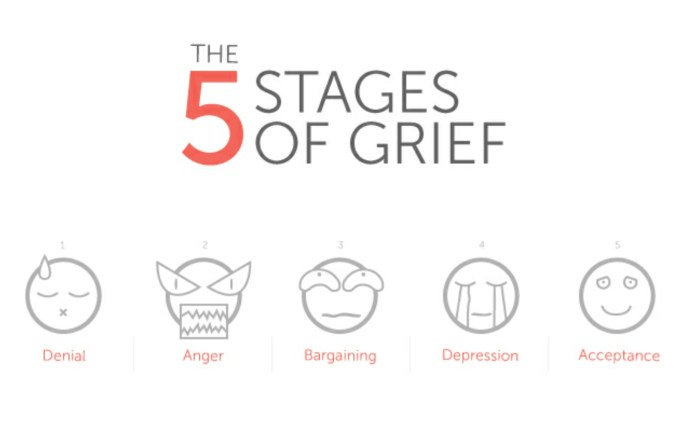
The five stages of grief are:

  1. Denial
  2. Anger
  3. Bargaining
  4. Depression
  5. Acceptance

They are the framework that makes up our learning to live without the one(s) we have lost. How we choose to deal with the grief can affect us for a long while after the news is first broken to us. During the denial stage, you cannot even believe the facts put in front of you. The person(s) you love is no longer here to hug you, tell you things will be okay, etc. Then usually after that, comes the anger. You are angry because they are no longer able to be present with you anymore. You may fight with someone, throw things, break things, or choose the creative expressions like dancing and/or art. Then there is the bargaining with God – or higher power, whichever you believe. We then begin bargain, saying we will do whatever as long as we get to have more moments with them. We are trying still to rationalize what has happened and even offering your life for theirs.

Depression is usually the toughest stage to get through. The preparations following a death can seem to be the hardest thing to do. Now you have to plan a ceremony, write about their impact and the memories they have left you with, burial or cremation, contact those who do not know what happened yet. There are just too many tiresome and daunting tasks to take care of when someone passes away. It can all be so overwhelming. These activities usually can either ease the depression or worsen it.

Acceptance is the final stage. This is also the most relieving stage. Even though you have gone through this incredibly terrible loss, you have finally reached the light at the end of the tunnel. There is a glimmer of hope that comes over you, they are no longer in pain. The gloom is no longer hanging over you as much and each day gets better and easier to deal with. Though we may all have to experience the loss of a loved one, it is helpful to understand what it is we are going through.

I hope that this post finds you well.

Namaste.

Forgiveness

How easy is it truly to forgive others for things done to you? Depending on your spiritual background, you are supposed to forgive others and forgive yourself on a regular basis. I started my spiritual journey as a Christian, raised in the church, and this is what I was taught from a very young age. When I was little the first thing I would think is “Why should I forgive them for hurting me?” It was always a question that I had unanswered in my mind because I did not understand the real meaning of forgiveness.

Matthew 6:14-15 reads as follows:

14 For if you forgive other people when they sin against you, your heavenly Father will also forgive you.
15 But if you do not forgive others their sins, your Father will not forgive your sins.

Once I found this passage, it became easier to understand the concept of WHY I should forgive others; however, I still did not understand exactly HOW to do that. It has still been a challenge, I am not perfect. To truly forgive someone though you have to be able to let go of the hurt and the pain associated with the trauma/situation. Take an abuse victim for example; they have constantly been hurt either physically, verbally, or mentally and still have to be able to forgive their abuser. That is if they want to begin healing, according to the Bible verse.

A lot of things are easier said than done, so HOW do you do it? For me, it is a process that I have changed over the years. I have tried to tell a person I forgive them for hurting me and have learned that telling them only confuses them. They ask more questions about why you are forgiving them and it re-opens the wounds you already closed. I have tried forgiving others and learned only later that I really did not when I see them again.

I have come to discover recently that forgiveness is all for you to do just for yourself. It is a covenant between you and God (or The Creator depending on your preference). It is only for you as an individual. We should all practice forgiveness, but I have found that it is best to not publicize your forgiveness of others. Most times they do not even feel they need to be forgiven and that is never a debate you want to get into if you are working on healing.

How do you forgive?

Breathe – Big Smile

It can be so easy to have a great day. All you have to do is start by taking a deep breath and smile. Smile big, smile bright, smile often.

Have you tried smiling your bad day away recently? I know I have had to. Just this morning as I was leaving out for work – on time and everything – the unthinkable happened. My bus that was scheduled to depart at 7:19 AM was there right when I walked out my house at 7:11 AM. Then I get to the train station and no train is in sight and over 150 people are standing and waiting. I wanted to scream, but instead I smiled and said to myself “it is going to be okay.” It is easy to just start yelling and saying “this is not fair” or “why did this have to happen to me?” or “could this get any worse?” or, in my case, blame the bus driver for speeding down the street and arriving early. I had no words for the train.

So even though things pretty much went south and had me late to work, I still reminded myself that maybe it was not meant for me to be on that bus. I will still get to work, I just will not arrive early as planned. There is nothing wrong with that. Letting all those negative thoughts leave out of my mind put me in a much better mood for the rest of my day ahead.

The best part of all this is every time I smiled, someone smiled right back at me. It made me feel good and I could tell the other person was in a good mood as well. It is amazing what something so small as a smile can do for you. So if you have not already done this today, put a smile on your face and enjoy the warmth of others smiling back at you!

smile-03

The Power of Positivity

Positivity

It’s a common concept that gets tossed around in numerous situations. With so many reasons to be negative, we have to find it in ourselves to be positive everyday and not let things get to us. It’s sometimes harder to keep positive on a regular basis, especially with all the crazy things that are going on in the world today. Why is it so important to keep positive? Well the energy you put out is the same energy you’ll receive back. If you emit positive energy, positive things will happen for you. Don’t believe me? Try it!

We constantly have a million and one thoughts going through our minds, not all of them are positive. So how do you change a negative thought into a positive one?

When that negative thought comes in your head, you have to immediately change it. Seems simple right? Not completely, not for everyone. Even I find myself having moments where I should have turned a negative thought into a positive one and instead I have just let it slide on by. However, with practice, comes the ability to really be able to succeed at this. Getting rid of the defeatist thoughts can be a challenge, but it’s very rewarding.

No more saying to yourself “I can’t do this,” or “the task is just too hard,” or “I’ll never get it right.” You have to say instead “I can do this, nothing is too hard for me, and I can get this task completed correctly.” One thing I always find that helps me to get rid of the defeatist thoughts is a scripture: “I can do all things through Christ who strengthens me.” Philippians 4:13.

That scripture is so powerful and it reminds us that we can do anything we set out to do with the strength of God through Christ. I also like to hum a tune in my head that sounds upbeat and sunny. Sometimes it’s a children’s song like BINGO or Pop Goes the Weasel, and other times it’s funny song I heard on YouTube. Either way it helps bring you out of your thoughts all together.

So give it a try and see the difference it’ll make in your life.


Mindful Breathing

I find that learning to breathe mindfully, is the first step to living a mindful life. It can be difficult when you’re just starting out, but it gets easier. The more you practice, the better you get. Mindful breathing helps you calm your mind. A calm mind is just the beginning to gaining a deeper understanding of yourself.

To make it easy I start with simply find a comfortable place to sit. You can also lay down if you want. In any case, make sure you keep your back straight. Get a timer, and set it to five minutes. While taking a deep breath in and letting it out, slowly close your eyes. To help you only focus on your breath; say the words “inhale” as you inhale your breath, and “exhale” as you exhale your breath. If at all your thoughts began to wonder, just bring your focus back to the words “inhale” and “exhale”.

Aim to practice mindfully breathing everyday for five minutes for a week. Pick a time of day, maybe after you brush your teeth in the morning and/or before you go to bed at night. It’s a good time frame to get you started. On the second week, you can extend your time frame to ten minutes everyday. The next week, fifteen minutes and twenty minutes by the forth week.